
Cleaning & Restoration · Emergency Recovery · Portfolio example
Platinum Restoration Services: Recovery & Local Growth
After two hacks in one year, we restored Platinum’s website and the owner’s confidence, then connected stronger hosting, local SEO, 250 landing pages, and 500 approved Search ads across a two-day recovery and rollout.
Work directly with Brian Bateman in Sheboygan, Wisconsin. Serving businesses locally and nationwide.
Emergency recovery · November 4–5, 2026
A restored website. A business owner who could feel confident again.
Platinum Restoration Services had already dealt with two website hacks in one year when Jeremy found us. Visitors were seeing gambling content instead of his cleaning and restoration services. Access was scattered across hosting, domain, WordPress, and Google accounts, and sorting it out was taking time away from his business.
The immediate job was to restore the website. The larger responsibility was to help Jeremy regain confidence in the people and systems looking after it. We recovered his existing site, worked through the connected accounts, and gave him a clear path from emergency repair to ongoing care.
The initial emergency restoration took two hours. The broader security, migration, website, local SEO, and advertising rollout followed across November 4 and 5. We kept the existing business, content, and customer contact workflow at the center of the work.
From urgent repair to a stronger foundation
Two days of connected work
- November 4 — recover and reconnect: regain account access, restore the existing WordPress site and content, correct domain routing, restore secure access, and establish the management access needed to continue.
- November 5 — address the recurrence and move: remove the returning malicious content, migrate the cleaned website to managed hosting, move DNS and business email, and review the wider account and recovery setup.
- November 5 — build the marketing foundation: repair service pages, publish a service-area landing-page system, improve local listings, connect measurement, and build and activate a matching Search campaign structure.
Speed mattered because every visitor reaching a hacked page was a lost opportunity to earn trust. Preserving the working parts mattered just as much: Jeremy needed his site and email back, with less disruption to the way he already served customers.
Security work that followed the whole customer journey
When malicious content returned, we expanded the recovery beyond the visible website. The cleaned site moved from its previous shared hosting to Elevel3 managed hosting protected by Imunify360. We retained recovery backups, corrected DNS and HTTPS routing, and reviewed administrative access across WordPress, hosting, the domain, and connected Google services.
We removed former-provider access while preserving site content, reviewed account recovery settings, and established management access through the appropriate account roles. Business email moved with its history and forwarding arrangements so Jeremy could continue using Gmail. Delivery checks confirmed that the migrated mail path worked.
This work gave Jeremy more than a clean homepage: it gave him a maintained foundation and someone accountable for the connected systems. No honest provider can promise that another attack is impossible. Our commitment is to high-end security measures, prepared disaster-recovery options, retained backups, and experienced people who can respond.
Experience matters in the parts you cannot see
A website can look finished while old administrator access, vulnerable components, neglected recovery settings, or disconnected hosting and email controls leave serious gaps. A quick, low-cost build may never include a review of those dependencies. If a provider does not know to check them, the owner may not discover the omissions until something fails.
Our work followed those connections. Recovery planning and security are part of operating a business website, alongside design, search visibility, and customer inquiries. Jeremy now has both a stronger foundation and a path to restore service if something goes wrong.
Organic search and customer relevance
250 landing pages built around real services and communities
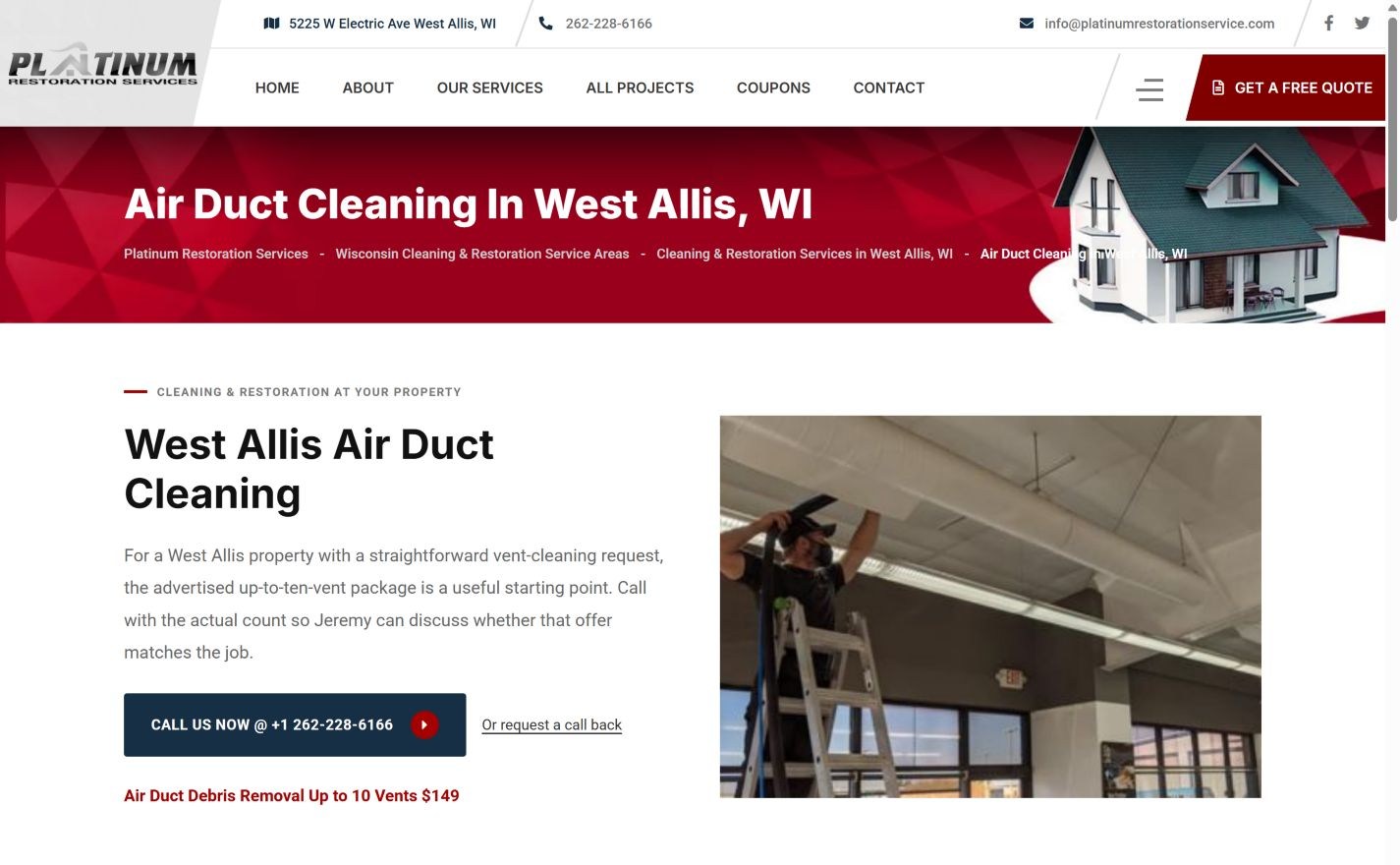
We first repaired ten existing service pages that had been redirecting visitors to the homepage. Then we built 250 service/location landing pages across 25 Wisconsin communities, organized under community hubs and a service-area directory.
Each combination received its own editorial content. Introductions, customer needs, practical questions, and service-planning details vary by page; the work goes beyond replacing one city name with another. Consistent descriptions of actual service procedures stay consistent where they should.
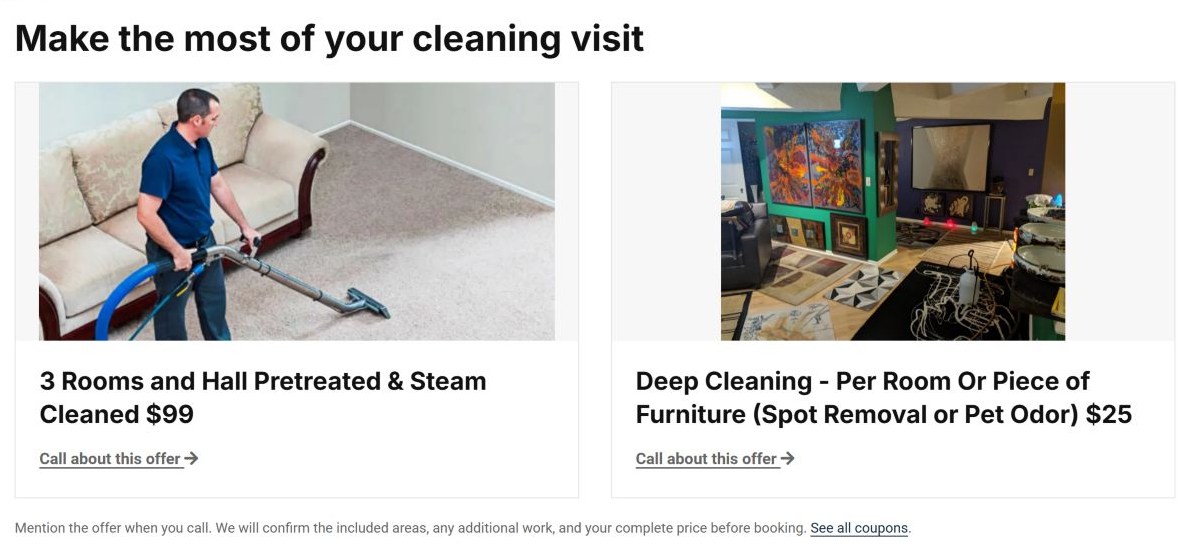
The pages carry the main site’s header, colors, imagery, and button styles. Matching coupons appear alongside the relevant services, and repeated call buttons reflect Jeremy’s preference for phone inquiries. A callback form remains available for visitors who prefer to write.
We checked the complete page set and reviewed examples across all 25 communities and ten service families. Desktop and mobile checks covered layout, navigation, images, offers, and contact routes.
Local SEO and ownership
Give the local presence the same attention as the website
We updated services and coverage areas on the client’s Business Profiles, including county coverage where appropriate, and aligned the customer-facing phone number with Jeremy’s preferred Google Voice number. The work supported his verified locations in West Allis, Kewaskum, Plymouth, Sussex, and Greenbush, with his unverified Mequon profile kept separate from eligible advertising locations.
We also worked through ownership and management access so future improvements could happen through the right accounts. Duplicate and unverified records were excluded from the advertising location selection. Business Profile edits and location inventory can remain subject to Google’s review and synchronization.
Organic search is the long-term foundation: useful service pages, understandable local coverage, consistent contact details, and a website that helps a visitor decide what to do next. Paid search supports that foundation with a direct route to the most relevant page.
A coordinated advertising rollout
250 Search campaigns. 500 approved ads. Matching destinations.
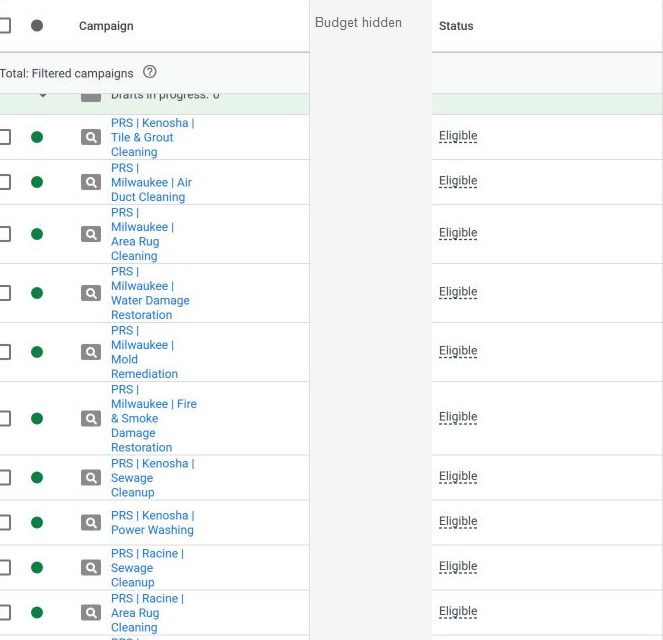
Through Splinternet Marketing, we built a Search campaign for each service/location combination, with two responsive ads and service-intent phrase keywords. Natural variations such as service-in-location and location-service connect to the same relevant destination.
The rollout included supporting assets, phone contact, geographic presence targeting, a business-hours schedule, and a shared budget with controlled starting bids. The old disqualified campaign stayed paused while the new structure was prepared and checked.
After authorization to launch, we activated the 250 new campaigns on November 5. The launch readback confirmed 250 enabled, eligible campaigns and 500 enabled, approved ads. The structure gives us a way to compare services and local markets as real inquiries arrive.
Approval and activation are deployment milestones. The next job is to find which searches produce worthwhile calls and booked work, then improve acquisition costs using that evidence.
Connect the clicks to the inquiries
We created and installed Google Analytics 4, verified the Search Console domain property, connected the relevant Google properties, and provided the client with access. Tracking covers phone-link clicks, form progress and successful submissions, scroll behavior, and navigation, with campaign attribution carried into the measurement plan.
A clearly labeled test inquiry reached the client’s email, and test events appeared in Analytics. That verified the test path from website interaction to inquiry delivery. Real paid leads, booked jobs, and acquisition costs require subsequent campaign data and client feedback.
What we achieved — and what comes next
Recovery first. Confidence restored. A direction for growth.
By the end of this two-day engagement, the business had its existing website restored on managed hosting, its email workflow preserved, a stronger account-management foundation, repaired service pages, 250 local landing pages, improved Business Profile information, connected measurement, and a newly activated Search campaign system.
Just as valuable was the human outcome: after two hacks earlier in the year, Jeremy could feel confident that his online presence now had active, coordinated care. He could return his attention to the cleaning and restoration work customers call him to do.
Publication snapshot: November 5, 2026. This case study documents delivered recovery and implementation work. The new campaigns had just been activated; ranking gains, lead volume, revenue growth, and lower acquisition costs had not yet been established. Ongoing work will measure those outcomes.
Need help getting your business back on track?
Whether the starting point is a hacked website, scattered account access, or marketing that needs a clear plan, work directly with Brian Bateman. DOYJO brings the website and technical work together with Elevel3 hosting and ongoing SEO and advertising through Splinternet Marketing.
Your next step
Let’s talk about your project.
Interested in an approach like this? Tell Brian about your business, the part of this example that interests you and what you want to improve.